















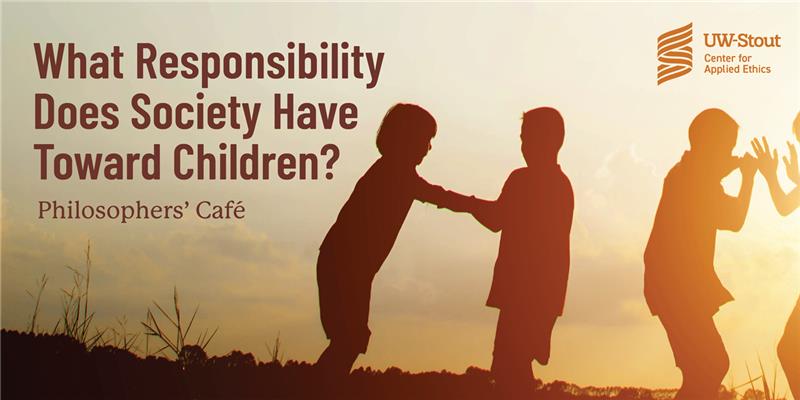
Philosopher’s Cafe is an event that the Center for Applied Ethics at UW-Stout hosts a couple of times a semester. This event creates a safe space for open discussions on philosophical debates and contemporary issues. Recently, they hosted an event titled “Philosophers’ Café: What Responsibility Does Society Have Toward Children?” There, Dr. Tina Lee hosted an open and respectful discussion regarding Child Protective Services (CPS) and America’s treatment of children.
To provide context for the discussion, Dr. Lee first offered some background information regarding CPS. She explained that while CPS started in the 1960s, its foundations were built on ideology from the 1930s and 1940s, with roots in the displacement of children from non-white homes. Drawing a historical parallel, Dr. Lee related this to the displacement of Indigenous children in residential schools, which took place during the same era.
She further explained how these practices were informed by the belief that poor families—often immigrants—could not properly raise their children. As with the ideology behind residential schools, the intent was to disrupt cultural continuity by removing children from their communities and placing them with white or non-immigrant families, thereby severing ties to their heritage. Dr. Lee recognized the parallels between the history of CPS and current events happening in places as close as Minneapolis. A conversation like this is topical in today’s climate, now more than ever, with ICE agents taking kids while they are in school. This poses the question of whether these practices are ethical or not.
As the discussion progressed, Dr. Alexander Bozzo, director at the Center for Applied Ethics, shifted the focus by introducing a scholarly article proposing a parental licensing agreement. According to the article, prospective parents would be required to obtain a license to have a child, much like the process for driving a car or owning a gun. This prompted debate about how America tends to require licenses for many things. Some participants argued that such a system could be weaponized in the U.S., just as CPS has been, by determining who is allowed to become a parent. Playing devil’s advocate, Dr. Bozzo pointed out that America already has similar systems that can be misused, such as CPS or even euthanasia. His central argument was that nearly any system can be weaponized, depending on how it is used.
One participant claimed it would be difficult to implement change to parenting in America because the country is family first, and it has always been family first, and implementing any law regarding children would be “admitting the government should have control of your children” (Feb 11, 2026).
The view was immediately opposed by another participant, stating that American family values are white family values, and if you don’t hold the same values, you are considered a bad parent by American societal standards. They went on to explain that history proposes these values were never family-oriented nor inclusive, indigenous boarding schools, and CPS, once again returning to the discussion as examples.
Another participant added to that point, saying that the “heterosexual normative family is innately oppressive and patriarchal” (Feb 11, 2026). Further explaining that when abuse occurs, the woman is often blamed for being unwell or unfit to be a mother.
From there, the conversation of raising a child in a community, vs only within the immediate family. In many cultures, raising a child within a community is the social norm, see the popular saying, “it takes a village.” A debate followed over whether exposure to multiple parenting perspectives benefits children or instead creates instability.
One participant argued that a child might feel confused if they have too many views to look into, suggesting that a single parental perspective could provide greater stability. People who were raised in a community with differing views then argued against that, using their religious upbringings as an example. They stated they were thankful to be raised in a community with many different religious views, because they were able to decide for themselves which religion truly suited them. They believe that only through getting out into the world and learning new and different things can you truly grow as a person and be your best self.
The discussion concluded with the thoughts that there is no “right” way to parent, and different cultures have different views on what the best way to parent is. Participants left with a question fresh in their minds: What does the future hold for the children of America?